✍️ Written by Dr. Raghuveer SN – Ayurvedacharya | Heartful Healer
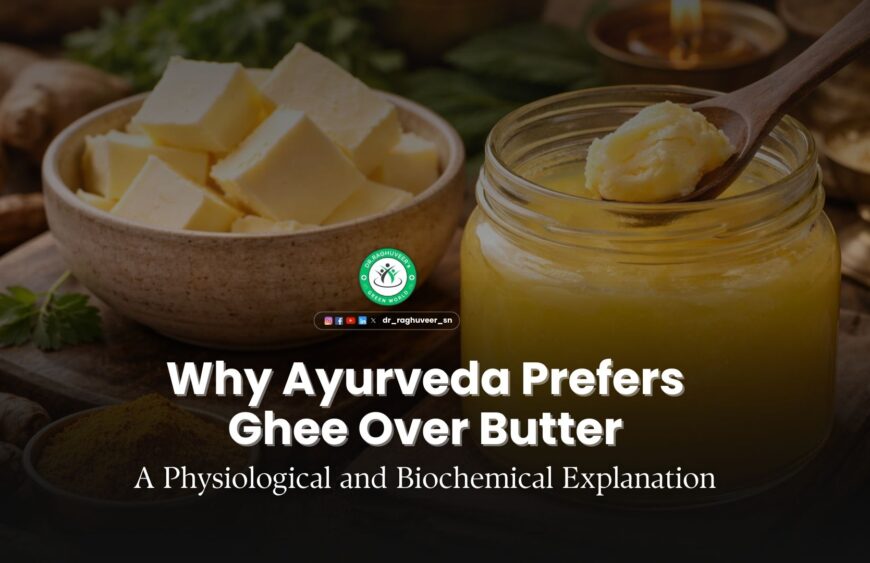
In many kitchens and nutrition discussions, ghee and butter are often treated as similar — both are dairy fats, both come from milk.
But Ayurveda draws a clear line between the two.
Ayurveda considers ghee a therapeutic fat — not out of cultural sentiment, but due to deep physiological reasoning. Modern biochemistry and gut-health science increasingly validate this ancient insight.
What Changes When Butter Becomes Ghee?
Butter contains:
- milk fat
- milk proteins (casein)
- milk sugars (lactose)
- and water
When butter is heated and clarified, lactose, casein, and water are removed, leaving only pure fat — rich in fat-soluble nutrients, short- and medium-chain fatty acids, and naturally occurring butyrate.
This transformation is what dramatically changes how the body digests and responds to ghee.
Digestive Physiology: The Agni Perspective
In Ayurveda, Agni — digestive fire — determines health.
Butter, because it still contains milk solids:
- requires stronger digestive effort
- can aggravate Kapha
- may increase mucus and heaviness
- triggers bloating in sensitive digestion
Ghee, being purified:
- digests easily
- supports Agni instead of burdening it
- is tolerated even in weak digestion
- leaves no metabolic residue (Ama)
Clinically, this means:
Patients with IBS, gastritis, weak appetite, or post-infection fatigue often respond better to ghee than to butter.
Metabolism and Cellular Uptake
Biochemically, ghee:
- contains short- and medium-chain fatty acids that bypass heavy digestion
- directly fuel mitochondrial energy production
- supports steady energy without sugar spikes
Ghee also contains butyrate — a gut-nourishing fatty acid known to:
- strengthen intestinal lining
- reduce inflammation
- support healthy microbiome balance
Science now confirms what Ayurveda hinted:
“Healing begins in the gut — and ghee nourishes the gut cells themselves.”
Heat Stability and Oxidative Stress
When choosing a cooking fat, its behavior under heat is critical.
Ghee
- has a high smoke point (~250°C)
- resists oxidation
- produces fewer inflammatory compounds
Butter
- burns quickly
- produces oxidized fats when heated
- contributes to oxidative stress and inflammation
Ayurveda’s emphasis on warm, well-cooked meals aligns perfectly — because only stable fats should be used in cooking.
Ghee as a Nutrient and Medicine Carrier
Ayurveda describes ghee as a Yogavahi — a substance that carries nutrients deeper into tissues.
Modern physiology explains this through:
- improved absorption of vitamins A, D, E, K
- enhanced bioavailability of herbal medicines
- efficient delivery of fat-soluble compounds into cells
This is why medicated ghees are foundational in Rasayana therapy, panchakarma, and neurological healing protocols.
Neurophysiological Benefits
Ghee supports:
- myelin sheath integrity
- cognitive clarity
- emotional stability
Ayurveda calls these Medhya effects — nourishing the intellect, memory, and nervous system.
Modern lipid-brain research now supports this — noting that healthy fats support brain volume, nerve lubrication, and neurotransmission.
My Clinical Observation
In my practice, when patients with:
- weak digestion
- inflammatory gut conditions
- metabolic imbalances
- high stress-eating patterns
replace butter or refined oils with moderate, guided use of ghee, they often report:
- improved digestion
- reduced bloating
- better morning hunger
- smoother bowel movements
- increased satiety
It is not about adding excess fat —
It is about using the right fat, in the right amount, at the right time.
Final Perspective
Ayurveda’s preference for ghee over butter is more than cultural habit — it reflects a profound understanding of:
✔ digestion
✔ metabolism
✔ inflammation
✔ nutrient transport
✔ mind-gut-body health
When used correctly, ghee is not merely a food — it is a functional medicine.
Ancient wisdom, when examined through modern science, reveals that Ayurveda was never guessing —
It was observing, understanding, and documenting physiology long before we named it.
Learn | Live | Love – Ayurveda
Dr. Raghuveer SN | Ayurvedacharya | Heartful Healer