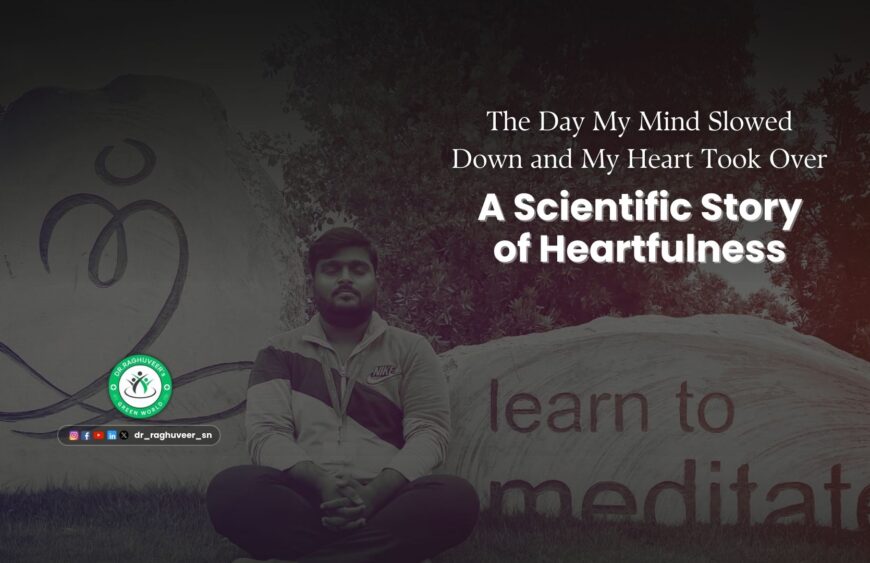
The Day My Mind Slowed Down and My Heart Took Over: A Scientific Story of Heartfulness
✍️ Written by Dr. Raghuveer SN – Ayurvedacharya | Heartful Healer
As clinicians, we are trained to trust the mind — analysis, logic, protocols, outcomes.
For years, I believed clarity was something the mind had to work harder to achieve.
I was wrong.
Clarity arrived the day my mind slowed down —
and the heart began to lead.
What followed was not an emotional episode or a belief-driven experience.
It was a measurable physiological shift.
When the Mind Overworks, the Body Pays
Modern medicine now confirms what Ayurveda described long ago:
an overstimulated mind creates a dysregulated body.
Chronic mental overactivity results in:
- persistent sympathetic dominance
- elevated cortisol levels
- increased inflammatory signalling
- disturbed digestion and fragmented sleep
- emotional and cognitive fatigue
This is not weakness.
This is neurobiology.
The Heart Is Not Symbolic — It Is Regulatory
Heartfulness introduced me to a reality that is often overlooked in clinical training:
The heart is a central regulator of the nervous system.
Heart-centered meditation produces:
- improved vagal tone
- stabilized heart–brain coherence
- a shift into parasympathetic repair mode
- reduction in stress and inflammatory markers
This is not metaphor.
This is measurable physiology.
The Moment the Shift Happened
During my early Heartfulness practice, something subtle yet unmistakable occurred.
Thoughts slowed — not through effort, but through ease.
Breath softened.
Muscle tension released.
Attention turned inward — naturally, without control.
The nervous system transitioned
from command to coherence.
That was the day the heart took over.
Why Heartfulness Works Differently
Unlike effort-based concentration techniques, Heartfulness functions through receptivity, not control.
The practice allows:
- mental quiet without suppression
- emotional regulation without analysis
- clarity without cognitive strain
The calm that emerges is sustainable, not temporary.
The Role of Heartfulness Cleaning
An equally essential component is the Cleaning practice, which supports emotional detoxification by clearing accumulated impressions from daily stress.
Clinically, this translates into:
- improved sleep quality
- reduced emotional reactivity
- enhanced stress resilience
- lighter, more stable mental states
A calmer inner environment accelerates physiological healing.
From Personal Experience to Clinical Insight
As a physician, belief was never enough.
What mattered was reproducibility.
Over time, I observed the same pattern in patients who adopted Heartfulness:
- deeper, more consistent sleep
- reduced anxiety and mental restlessness
- improved metabolic and hormonal balance
- greater compliance with lifestyle corrections
When the mind settles,
the body follows.
Ayurveda Already Understood This
Ayurveda describes this transition as a movement from Rajas to Sattva —
from agitation to clarity.
Heartfulness offers a practical, accessible way to cultivate this state daily —
without withdrawal from life, work, or responsibility.
Final Reflection
The mind is a remarkable instrument —
but it was never meant to lead alone.
When the heart assumes its rightful role:
- decisions become clearer
- actions become calmer
- healing becomes faster
That day, my mind slowed down.
And medicine became more human.
Learn | Live | Love – Ayurveda
Dr. Raghuveer SN
Ayurvedacharya | Heartful Healer