✍️ Written by Dr. Raghuveer SN – Ayurvedacharya | Heartful Healer
Hormonal health in women is often discussed in terms of ovaries, thyroid function, or stress levels. While these are important, emerging research highlights another powerful regulator — the gut microbiome.
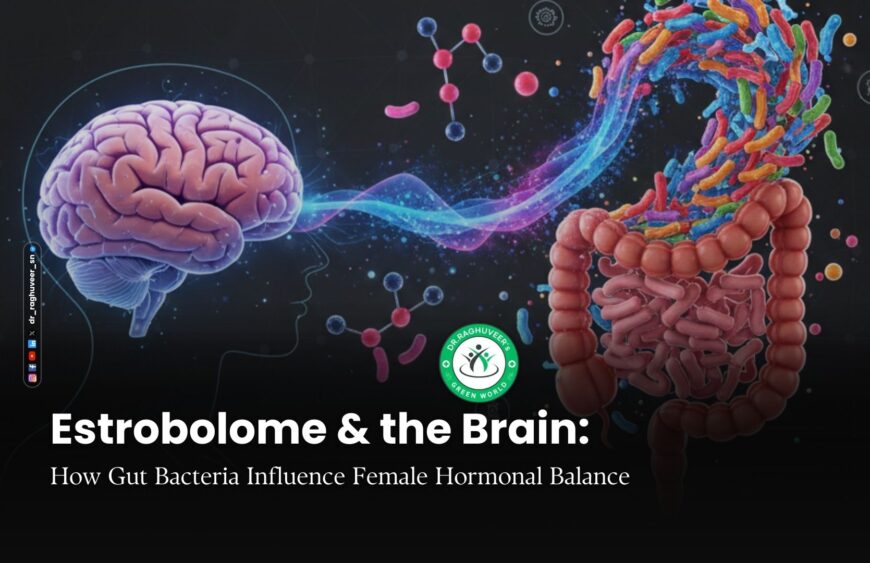
Within this vast microbial ecosystem lies a specialized subset of bacteria known as the estrobolome, which plays a critical role in estrogen metabolism.
Understanding how the estrobolome interacts with the brain offers a deeper and more integrated view of female hormonal balance.
What Is the Estrobolome?
The estrobolome refers to the collection of gut bacteria capable of metabolizing estrogen.
After estrogen is processed in the liver, it travels to the intestine for elimination. Certain gut bacteria produce an enzyme called beta-glucuronidase, which can reactivate estrogen and allow it to re-enter circulation.
When this system functions optimally:
- Estrogen levels remain balanced
- Hormonal cycles are smoother
- PMS symptoms may reduce
- Mood fluctuations become less intense
When dysregulated:
- Estrogen dominance may develop
- Irregular cycles may appear
- Acne and bloating may worsen
- Heavy or painful periods may increase
- Emotional instability may intensify
The gut, therefore, acts not just as a digestive organ — but as a hormonal regulator.
The Gut–Brain–Hormone Axis
The gut and brain are in constant communication through:
- The vagus nerve
- Immune signaling pathways
- Neurotransmitter production
- Stress hormone cascades
Gut bacteria influence the production of serotonin, dopamine, and GABA — neurotransmitters that regulate mood, cognition, and emotional resilience.
This explains why women experiencing gut imbalance may report:
- Premenstrual anxiety
- Brain fog
- Irritability
- Disturbed sleep
- Emotional sensitivity
Hormonal balance is therefore not purely endocrine — it is neuro-metabolic.
Modern Lifestyle and Estrobolome Disruption
Several lifestyle factors can disrupt the gut microbiome and estrogen metabolism:
- Highly processed diets
- Excess refined sugar
- Repeated antibiotic use
- Chronic psychological stress
- Poor sleep quality
- Sedentary habits
These factors do more than disturb digestion. They alter estrogen recycling, increase inflammatory signaling, and reduce stress resilience.
Over time, this can manifest as hormonal irregularities.
The Ayurvedic Perspective: Agni, Ama, and Artava
Ayurveda has long described the intimate relationship between digestion and reproductive health.
Agni (Digestive Fire)
Strong Agni ensures proper transformation of nutrients and hormonal precursors. Weak digestion disrupts metabolic clarity.
Ama (Metabolic Toxins)
Incomplete digestion leads to Ama accumulation, which obstructs channels and disturbs systemic balance, including hormonal rhythms.
Artava Dhatu
The reproductive tissue in women depends on balanced nutrition, efficient digestion, and mental stability.
From this perspective, hormonal imbalance often begins in the gut — long before it appears in lab reports.
Supporting a Healthy Estrobolome
Dietary Foundations
Favour:
- Fiber-rich vegetables
- Seasonal fruits
- Fermented foods (if tolerated)
- Whole grains in moderation
- Adequate hydration
- Warm, freshly prepared meals
Minimise:
- Refined sugars
- Ultra-processed foods
- Excess alcohol
- Late-night eating
Personalization remains essential based on constitution and condition.
Movement and Yogic Support
Regular movement enhances gut motility, circulation, and endocrine balance.
Supportive practices include:
- Gentle twisting asanas
- Baddha Konasana for pelvic circulation
- Setu Bandhasana for endocrine support
- Surya Namaskar for metabolic activation
Consistency matters more than intensity.
Mudras for Hormonal Stability
Mudras can support energetic alignment when practiced regularly:
- Yoni Mudra — supports reproductive steadiness
- Apana Mudra — assists elimination and pelvic health
- Gyan Mudra — enhances mental clarity
These serve as complementary tools alongside lifestyle correction.
Heartfulness Meditation and the Stress–Hormone Loop
Chronic stress disrupts female hormonal balance through cortisol-driven pathways.
Heartfulness meditation helps:
- Reduce sympathetic overactivation
- Improve emotional resilience
- Support deeper sleep
- Enhance gut–brain communication
When the nervous system stabilizes, hormonal rhythms often follow.
A regulated mind creates a regulated physiology.
A Clinical Reflection
Instead of asking:
“Which hormone is out of balance?”
A more integrative approach may ask:
- How is digestion functioning?
- Is stress being managed effectively?
- Is sleep restorative?
- Is the gut microbiome supported?
Female hormonal health is not a single-organ issue. It is an integrated system involving metabolism, microbiome, brain chemistry, and emotional well-being.
Final Thought
The estrobolome reveals an important truth:
Hormonal balance is not only about glands.
It is about the gut, the brain, metabolism, and emotional health functioning in harmony.
When these systems are addressed together, sustainable balance becomes possible — not as suppression, but as restoration.
Learn | Live | Love – Ayurveda
Dr. Raghuveer S.N.
Ayurvedacharya | Heartful Healer